

Traditional employee feedback surveys lean heavily on favorability scores that may look good on paper but lack predictive and actionable value. An employee selects Excellent, Very Good, or Good. Then leadership combines “Very Good” and “Good” responses and labels them as “favorable.”
The number often looks reassuring, but it can hide an important distinction.
An Excellent rating signals a different experience than a Good or Very Good rating. All three responses are positive, but they do not represent the same level of employee experience.
Work Institute believes that distinction matters.
If the goal is to understand the employee experience and its relationship to retention, organizations should know more than how many employees are favorable. They should know how many are experiencing excellence and why they feel that way.
Favorable Can Hide an Important Distinction
Imagine an organization reports that 80% of employees gave a favorable rating to their manager.
At first glance, that sounds strong, but what does that 80% actually represent?
It could include employees who rated their manager Excellent, Very Good, and Good. Those employees are not necessarily describing the same experience.
Work Institute’s Q2 2026 data illustrates the difference.
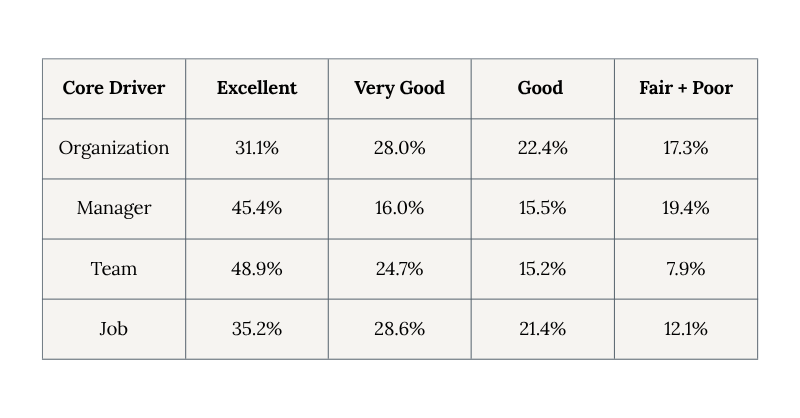
If Good and Very Good are combined the resulting favorable score is quite high across all four areas.
But that combined number doesn’t tell leaders how many employees believe their experience is excellent.
An employee who rates their experience as Good is not having the same experience as an employee who rates it Excellent. Both responses are favorable, but they are not equivalent.
There is also evidence that Favorable scores do not reliably predict intent to stay. This helps explain why organizations can have high Favorability scores and still experience significant employee turnover.
The problem isn’t the Favorable score itself. The problem is what leaders assume it tells them about the health of the workforce.
Positive Isn’t the Same as Excellent
This is not an argument that Very Good or Good ratings are negative. The question is whether positive should be the standard organizations use to evaluate the employee experience.
Work Institute believes it should not.
There is meaningful difference between an employee saying: “My manager is good” and “my manager is excellent.”
Both employees gave positive feedback but the second employee described a stronger experience. That distinction becomes particularly important when organizations want to understand what creates an employee experience that people value enough to stay.
A “good” manager and or organization is the bare minimum. Excellence is attainable.
Why We Measure Net Excellence Scores (NES)
We replace inflated favorability ratings with a higher standard. Net Excellence Scores (NES) highlights what’s excellent and not just what’s favorable. This raises expectations and drives improvement.
NES is calculated by taking the percentage of employees who rate an area Excellent and subtract the percentage who rate it Fair or Poor.
NES = Excellent – (Fair + Poor)
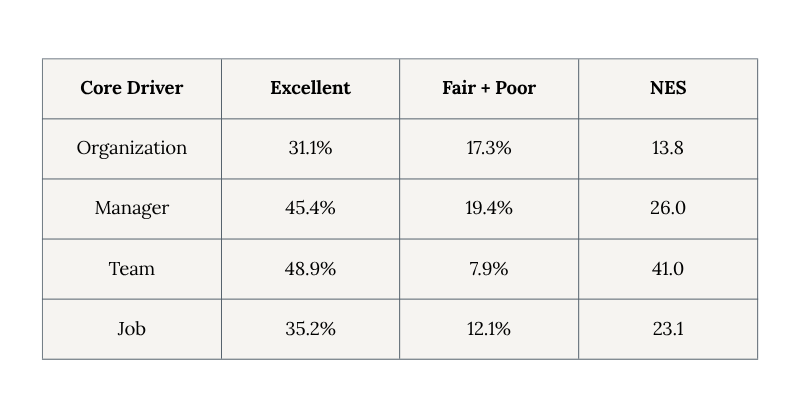
Our methodology is intentional. Rather than treating every positive response as equal, NES establishes excellence as the standard while keeping negative experiences visible.
This gives leaders a clearer view of where employee experiences are exceptional and where there is opportunity to improve.
What Are You Missing Inside “Favorable?”
Consider the Q2 Organization ratings again. Nearly 1/3 employees rated their organization Excellent. Another 28% rated it Very Good, and 22.4% rated it Good.
The combined results Favorable results look overwhelmingly positive, but there is a large difference between an employee who says their experience is Excellent and one who says it is good.
That difference creates an opportunity for leaders to ask better questions like:
- What would make employees rate their manager Excellent?
- What would make the job experience exceptional?
- What is preventing a positive experience from becoming an excellent one?
The goal is not to turn a positive score into a negative story. The goal is to avoid letting a positive score become the end of the conversation.
Don’t Let Favorable be the Finish Line
When Favorable becomes a primary measure of success, organizations are settling with Good and that matters to retention.
The goal of retention isn’t to eliminate the worst employee experiences. It is to create an organization, manager effectiveness and relationship, team environment, and job experience necessary that employees value and thrive.
Work Institute’s four Core Drivers of Retention provide a way to measure and examine those experiences.
- Organization
- Manager
- Team
- Job
NES provides a way to distinguish excellence in each. The goal is to understand what makes an employee’s experience excellent and create more of it.
Want to Know More Than Your Favorable Score?
Employee feedback results should help you understand where the employee experience is strong, where it can improve, and what those experiences mean for retention.
Work Institute helps companies move beyond aggregated survey scores to understand the conditions that shape employee engagement and retention in your organization.