

Most organizations look at turnover as a single number, but the rate alone does not tell you what‘s happening within the workforce.
Work Institute’s Quarterly Workforce Trends Report analyzes more than 3,200 employee exit interviews to uncover the trends shaping turnover today, including quarter-over-quarter changes in why employees leave and how they rate their workplace experience.
Several reasons for leaving shifted meaningfully from Q1 to Q2:
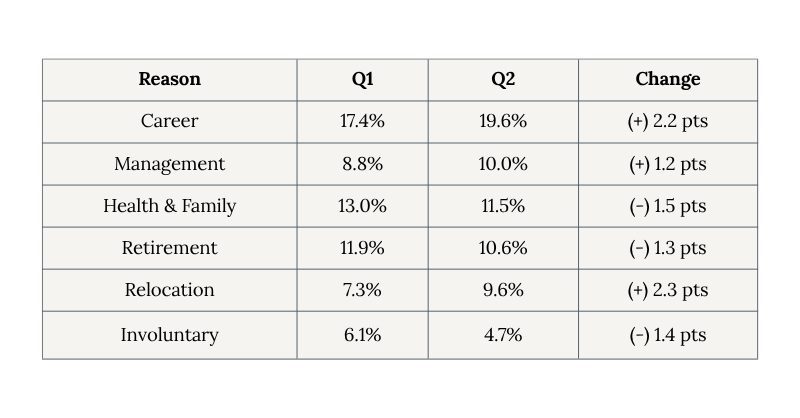
Career remained the leading reason employees left, but its share of separations increased another 2.2 percentage points to 19.6% in Q2. Management-related departures also increased, while Health & Family and Retirement declined.
These shifts don’t necessarily change the long-term priorities of every organization, but they do provide a signal about where workforce pressures are moving.
Turnover Rate is Only Part of the Story
When leaders talk about turnover, the conversation often starts and ends with “Our turnover is X%.”
That rate matters and is important, but it does not tell why employees leave, whether those reasons are changing, or where retention risks are emerging.
Three organizations could all identify Career as their leading reason for leaving while having very different underlying retention challenges.
One may need to address advancement. Another may need to address development. Another may need to create greater visibility into career paths.
Same turnover rate. Different problems. Different solution.
That is why understanding the reasons behind turnover matters.
Work Institute’s approach goes beyond identifying the primary reason an employee leaves. Each of the 10 primary categories is further broken down into specific employee-reported drivers. That level of detail helps organizations move from knowing what is happening to understanding what employees are actually experiencing.
Your Retention Strategy Should Move with the Data
The Q2 report shows us what changed from Q1. But the next question is why did it change?
Retention strategies should not be rebuilt every quarter, but they should be reassessed every quarter.
A strategy designed around the most significant retention challenges of a previous year may not address the challenges employees experience today. Quarterly data provides an opportunity to revisit those priorities and determine if the company’s attention is focused in the specific places it should be.
Quarterly data shouldn’t cause organization to change direction every three months. The point is to use your current data to determine whether your retention strategy is still focused on the problems your employees are currently experiencing.
Don’t Just Track Turnover. Track What is Changing with It.
Employee turnover is an important outcome that should be tracked and understood by organizations, but the reasons behind it provide the strategic insight.
Looking at those reasons over time helps leaders distinguish between persistent retention challenges and emerging ones. It also creates an opportunity to determine whether the organization’s current retention efforts are addressing the issues employees are actually experiencing.
The most valuable question is not simply: “How much turnover did we have?”
It is: “What are employees telling us about why they are leaving, and how is that changing?”
Organizations that consistently listen to their employees can adjust their retention efforts based on evidence rather than assumptions.
Retention is not a one-time problem to solve. It is an ongoing process of understanding what employees need, what is changing, and where the organization can improve.
Because employee turnover is not static. And your understanding of it should not be either.
Want to Understand What’s Driving Your Turnover?
Turnover tells you who is leaving. Employee feedback tells you why.
Work Institute helps organizations go beyond the turnover number to understand the reasons employees leave, the specific drivers behind those reasons, and how those drivers change over time.
Learn how Work Institute can help you turn employee feedback into a more informed retention strategy.