

Our Quarterly Workforce Trends Report — Q1 2026 provides an early look at employee turnover patterns based on 2,888 exit interviews conducted in the first quarter of 2026.
Below is a high-level view of two key areas:
- Why employees are leaving
- How they rate their workplace experience
Top Reasons for Employee Turnover (Q1 2026)
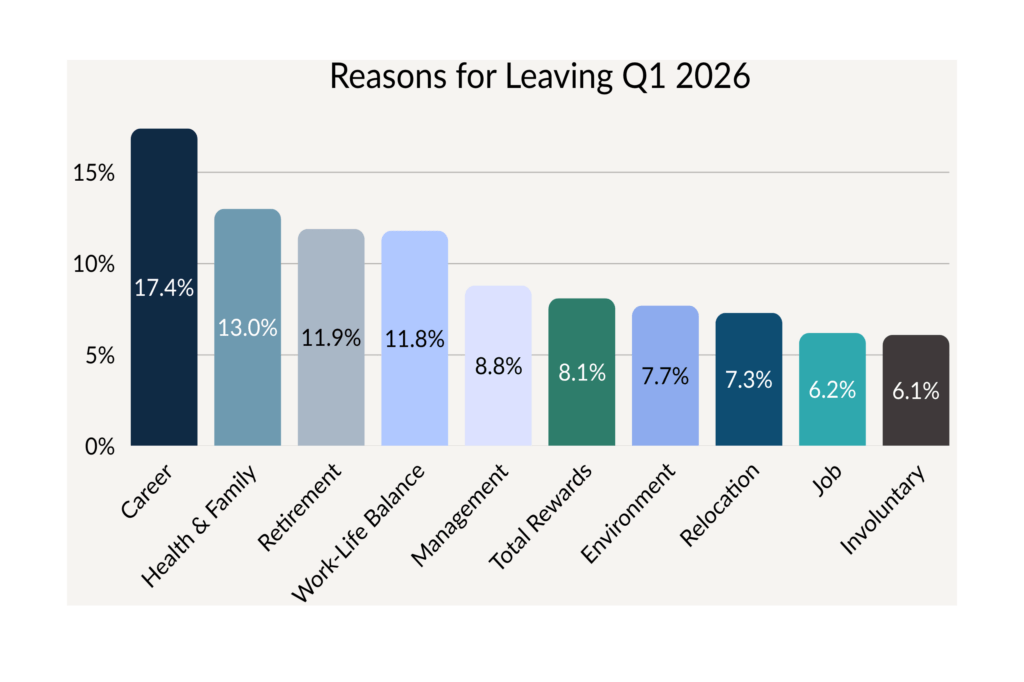
Career-related exits accounted for the largest share of separations (17.4%), followed by Health and Family (13.0%), Retirement (11.9%), and Work-Life Balance (11.8%).
Management-related turnover represented 8.8% of exits, while Total Rewards accounted for 8.1%.
Together, these categories reinforce the broad range of factors influencing employee decisions to leave.
While these categories provide useful context, they represent broad groupings. Each organization experiences these drivers differently based on its workforce, leadership, and operating environment.
Employee Ratings Across Core Drivers of Retention & Engagement
Employees rated their teams (50.0% Excellent) and managers (44.5% Excellent) more favorably than the organization overall (30.8% Excellent).
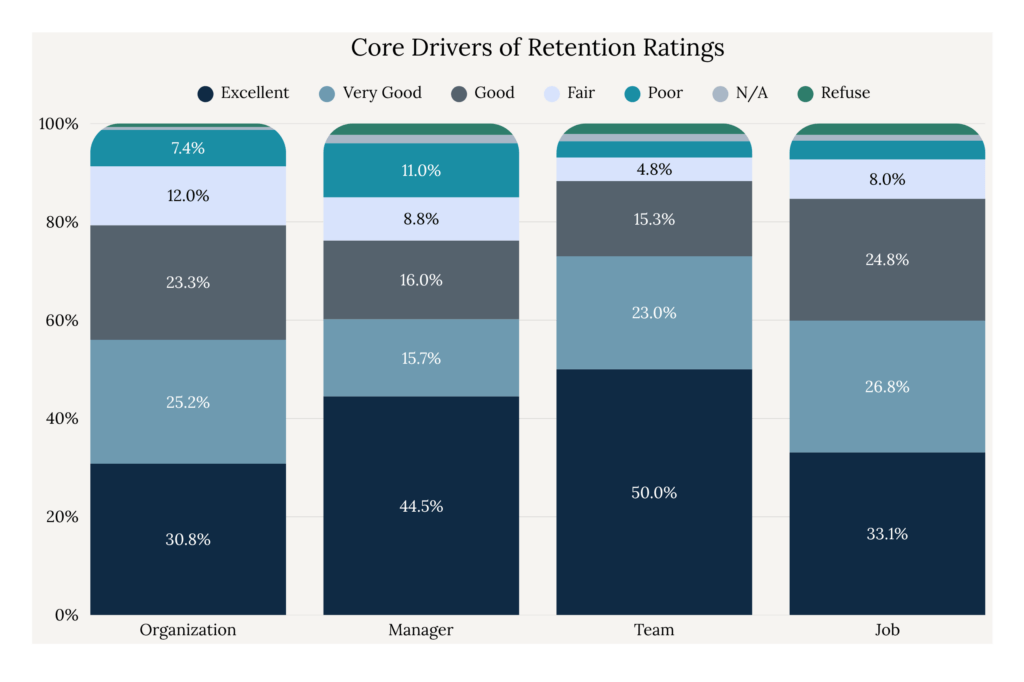
These ratings reflect how employees perceive four core areas that influence retention and engagement:
- Organization
- Manager
- Team
- Job
These perceptions play a central role in shaping employee behavior, including engagement levels and turnover decisions.
First-Year Turnover Remains Elevated
28.4% of employees who left in Q1 had less than one year of tenure.
Early-tenure exits continue to represent a significant share of overall separations.
For a deeper breakdown of turnover drivers and workforce trends, explore the full Quarterly Workforce Trends Report.
To better understand how workforce data should be interpreted within your organization, read:
What Employee Retention Data Can and Cannot Tell You